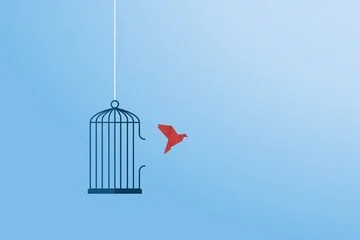
From Fear to Freedom…
Moving from fear to freedom often begins with understanding what your body and brain have been trying to do for you. When pain feels scary, it is very natural to avoid the movements or activities that seem to bring it on. This is called the fear-avoidance loop. The difficult part is that, over time, avoiding movement can reduce strength, confidence, and trust in your body, which can make everyday things feel even more threatening.
Healing is not about pretending the pain is not there, pushing through, or telling yourself to “just get over it.” It is about gently changing your relationship with the sensations you feel. Instead of seeing every discomfort as a warning that something is wrong, you can begin to meet those sensations with curiosity, patience, and care. Pain is real, and it deserves to be listened to, but pain does not always mean damage or danger.
If you believe something is structurally wrong, it can be incredibly hard to feel safe in your own body. You may find yourself wondering, “What if I make it worse?” every time you sit, bend, walk, lift, or exercise. That fear makes sense. Your brain is trying to protect you. It may respond by creating tightness, guarding, pain, or hesitation. This does not mean you are broken. It means your nervous system has learned to be protective, and with time, it can learn something new.
One of the most powerful ways to communicate safety to your brain is through small, repeated experiences that feel manageable. You do not have to leap straight back into everything you used to do. You can start where you are. Choose a movement that feels safe enough, move gently, breathe slowly, and notice what your body can do today. Every calm, successful repetition gives your brain new evidence: “I can move, and I am okay.”
· Start with a movement that feels safe enough for you today.
· Breathe slowly and remind your body that you are not in danger.
· Notice the small wins, such as moving with a little more ease or feeling less guarded.
· Build up gradually, one step at a time, instead of testing or forcing your limits.
· Speak to yourself with kindness: discomfort can be a signal, not a sentence.
Freedom does not usually arrive all at once. It often grows quietly, through small moments of trust: sitting a little longer, walking a little further, moving with a little less fear. As you begin to see your body as adaptable rather than fragile, your brain can slowly learn that pain does not have to be in charge of every decision.